

An ETF (exchange-traded fund) is a pooled investment security that holds a basket of assets and trades on a stock exchange just like a regular stock. The global ETF market holds over $22 trillion in assets under management, with three giants holding almost $13 trillion. BlackRock holds $6.1 trillion in assets through iShares, Vanguard holds $4.7 trillion mostly in ETFs tracking US equity indices, while State Street (SPDR) manages $2.2 trillion. This reflects the massive popularity of ETFs among modern investors. Whether you are building a long-term portfolio or making short-term trades, using ETFs offers an accessible way to achieve diversification, keep costs low, and maintain high liquidity throughout the trading day.
- Single security, multiple assets: An ETF holds a basket of assets (like stocks or bonds) within a single investable instrument.
- Intraday trading: Unlike some traditional funds, ETF shares are bought and sold on a stock exchange throughout the day at market-determined prices.
- Index tracking: The majority of ETFs are passively managed and designed to track the performance of a specific market index.
- Dual returns: Investors can generate returns through both the market price appreciation of the shares and any dividends paid out by the underlying assets.
An ETF (exchange-traded fund) is a pooled investment security that holds a basket of assets and trades on a stock exchange just like a regular stock. The global ETF market holds over $22 trillion in assets under management, with three giants holding almost $13 trillion. BlackRock holds $6.1 trillion in assets through iShares, Vanguard holds $4.7 trillion mostly in ETFs tracking US equity indices, while State Street (SPDR) manages $2.2 trillion. This reflects the massive popularity of ETFs among modern investors. Whether you are building a long-term portfolio or making short-term trades, using ETFs offers an accessible way to achieve diversification, keep costs low, and maintain high liquidity throughout the trading day.
- Single security, multiple assets: An ETF holds a basket of assets (like stocks or bonds) within a single investable instrument.
- Intraday trading: Unlike some traditional funds, ETF shares are bought and sold on a stock exchange throughout the day at market-determined prices.
- Index tracking: The majority of ETFs are passively managed and designed to track the performance of a specific market index.
- Dual returns: Investors can generate returns through both the market price appreciation of the shares and any dividends paid out by the underlying assets.
What is an ETF (exchange-traded fund)?
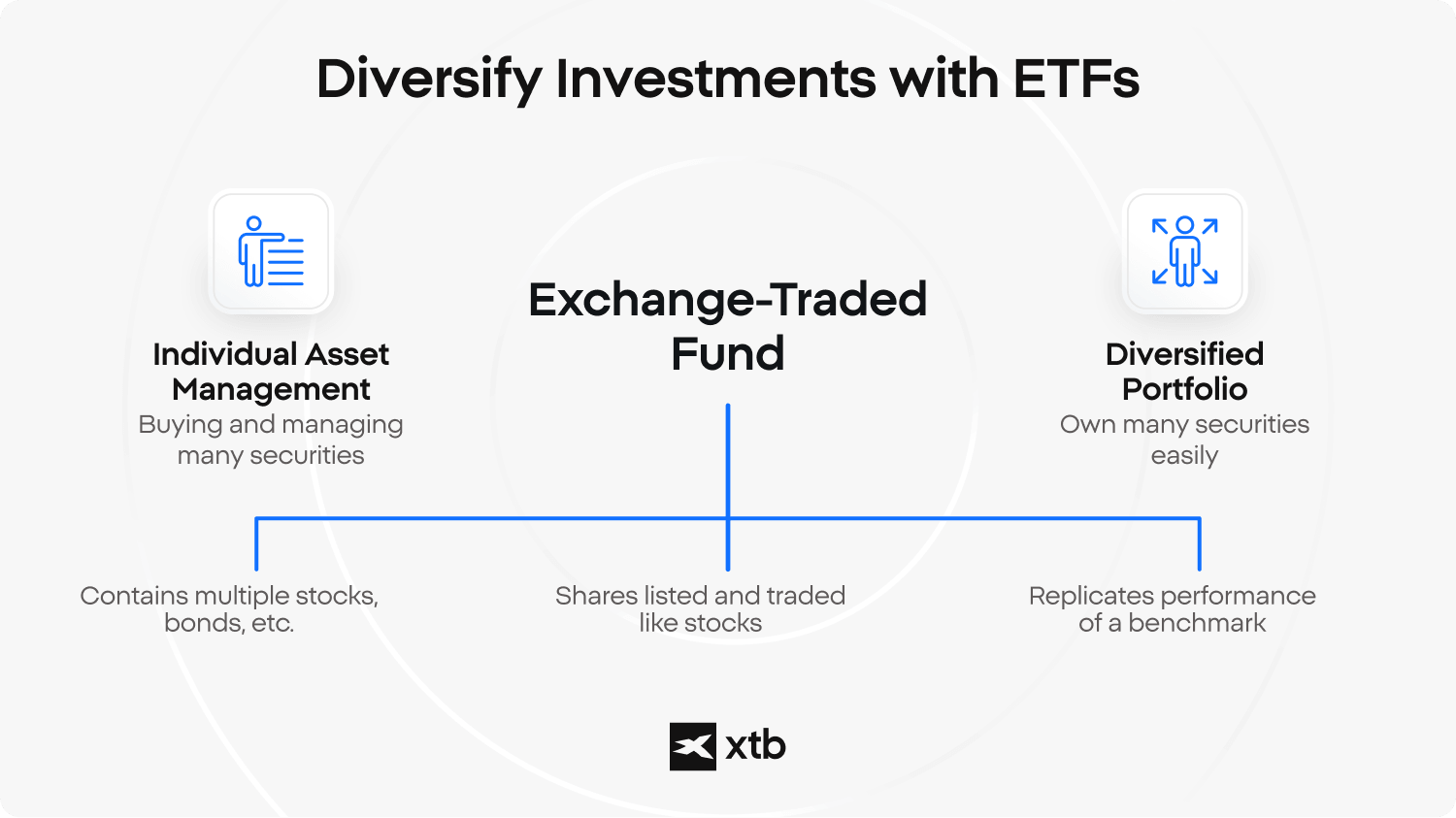
An exchange-traded fund (ETF) is a single financial instrument that holds a basket of assets, such as stocks, bonds, or other securities, whose shares are listed and traded on a stock exchange, much like an individual stock.
The acronym stands for "exchange-traded fund", which perfectly describes its fundamental nature. When you buy a single share of an ETF, you are essentially purchasing a tiny, proportional slice of everything that the fund holds in its overarching basket of assets. This structure allows you to own dozens, hundreds, or even thousands of underlying securities without having to buy and manage each one individually.
From a legal and regulatory standpoint, an ETF is a collective investment vehicle typically registered as an open-end investment company or a unit investment trust, depending on the local jurisdiction. This regulated status ensures strict rules regarding transparency, daily holding disclosures, and how the fund operates on behalf of its shareholders.
While some are actively managed, the vast majority of these funds are designed to track indices. This means the ETF aims to replicate the performance of a specific benchmark, such as a broad market index of large-cap equities. Because of this, you will often see the ETF meaning treated as synonymous with passive investing, as the fund mechanically follows its assigned index rather than relying on a manager to pick winning stocks.
How does an ETF work?
An ETF works by mechanically tracking the value of a baseline index or a basket of assets, with its shares being priced and traded on a stock exchange continuously throughout the trading day at a market-determined price. To achieve its goal of mirroring an index's return, an ETF typically uses one of two replication methods. Physical replication means the fund actually buys and holds the underlying assets (like stocks and bonds) in the exact proportions of the target index. Synthetic replication uses financial derivatives like swaps to replicate the index's return without owning the physical assets directly—a rarer approach often used for hard-to-access niche markets.
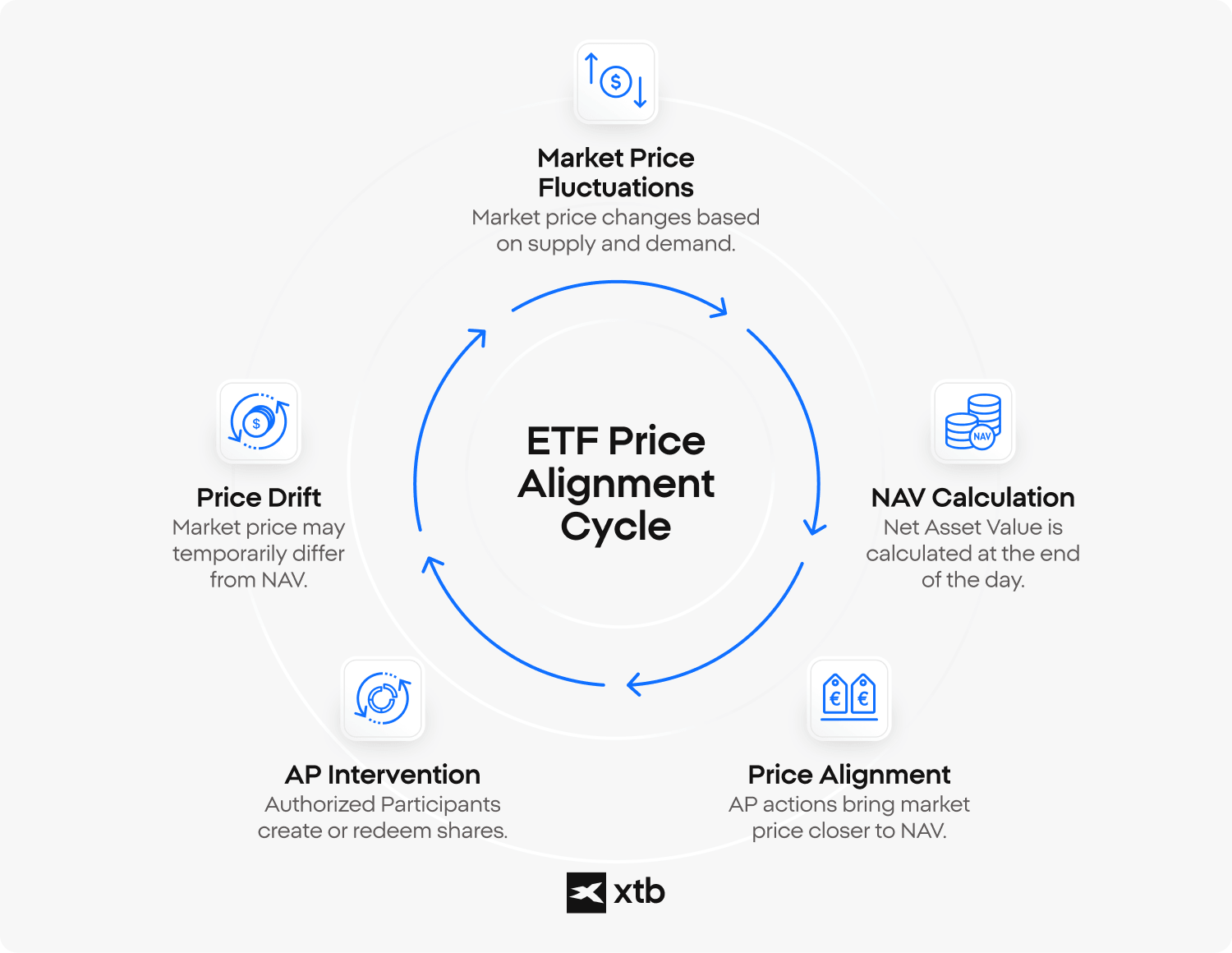
The price you see on the trading platform is the market price, which fluctuates intraday based on real-time buyer and seller demand. However, the actual underlying value of the fund's holdings is its Net Asset Value (NAV), calculated once at the end of the trading day. Because market price and NAV can temporarily drift apart, an ETF might occasionally trade at a slight premium (above NAV) or discount (below NAV).
To keep the market price closely aligned with the NAV, the ETF relies on a unique creation and redemption mechanism. Specialised institutional investors known as Authorized Participants (APs) can create new ETF shares by delivering the underlying basket of assets to the fund, or redeem ETF shares for the underlying assets. This arbitrage process absorbs excess supply or demand, ensuring the share price stays closely aligned with the actual value of the holdings.
When you hold these shares, your investment generates returns from two main sources. First, you profit from capital appreciation if the market price of the ETF shares increases. Second, you are entitled to a portion of the cash flows generated by the underlying basket of assets, which is why understanding what a dividend is - is crucial for income-focused ETF investors.
|
|
What types of ETFs are there?
ETFs are broadly categorised by their underlying asset classes and investment strategies, including equity ETFs, bond ETFs, commodity ETFs, thematic ETFs, and funds offering exposure to cryptocurrencies.
The most common category is the equity ETF, which holds a basket of publicly traded companies. Within this umbrella, index ETFs passively track broad market benchmarks, while sector ETFs focus on specific industries, such as technology, healthcare, or energy. For instance, investors interested in hardware manufacturing might look into semiconductor ETFs to gain targeted exposure to that specific niche.
Beyond equities, bond ETFs provide exposure to fixed-income securities, including government treasuries, municipal bonds, and corporate debt, typically offering lower volatility and regular yield. Commodity ETFs track the price of physical goods like gold, silver, or agricultural products, often using futures contracts rather than holding the physical commodity. Multi-asset ETFs combine various classes—like stocks and bonds—into a single, balanced portfolio.
In recent years, the market has expanded to include thematic and alternative ETFs. Thematic ETFs are designed to provide exposure to specific long-term investment themes, such as clean energy, artificial intelligence, or other structural changes shaping the economy. Additionally, crypto ETFs have emerged as a way for investors to gain exposure to digital assets like Bitcoin or Ethereum through a traditional brokerage account, bypassing the need to manage digital wallets directly. While passive funds dominate the landscape, there are also actively managed ETFs where a portfolio manager makes daily decisions to try to outperform the broader market.
How is an ETF different from stocks, mutual funds and index funds?
Unlike an individual stock, an ETF instantly provides a diversified exposure to multiple assets, and unlike a traditional mutual fund, it is traded on a stock exchange intraday at market prices rather than being priced just once a day at its NAV.
ETF vs. Single Stock: The primary difference is concentration risk. Buying a single stock ties your investment to one company, whereas an ETF acts as a diversified basket, cushioning the impact of a single poorly performing asset.
Mutual Funds and Index Funds: The contrast between an ETF and a mutual fund primarily comes down to how and when they are traded. A mutual fund is bought and sold directly through the fund company at a single price (the NAV) calculated at the end of the trading day. In contrast, an ETF trades on a stock exchange throughout the day, allowing investors to execute limit orders, utilise stop losses, and trade on margin just as they would with a normal stock.
It is also common to confuse an ETF with an index fund. An index fund represents a broad strategy (tracking an index) rather than a specific product structure. Both an ETF and a mutual fund can technically be "index funds" if they track a benchmark. The difference lies purely in the vehicle: the ETF trades continuously on an exchange, while the mutual fund prices once daily. For those exploring derivative trading vehicles, comparing an ETF vs CFD is also important, as they represent entirely different mechanisms for interacting with price movements.
What are the advantages and downsides of ETFs?
The primary advantages of an ETF include instant diversification, highly competitive low costs, and robust liquidity, while the main downsides involve unavoidable market risk, potential tracking error, and standard trading costs like spreads and commissions. The biggest advantage of an exchange-traded fund is the ability to achieve broad market diversification in a single transaction, which makes executing various asset allocation models highly efficient.
Because most ETFs are passively managed, they feature remarkably low operating expenses. The Total Expense Ratio (TER) for a broad index ETF can often be as low as 0.05% to 0.5% annually. Finally, the fact that they trade on a stock exchange ensures high liquidity, allowing investors to enter and exit positions easily during standard market hours.
Investing in an ETF is not without its downsides. The most significant is systemic market risk; an ETF only provides diversification against individual company failures, meaning if the entire index drops, the ETF's value will fall with it. Furthermore, investors face the risk of tracking error. This occurs when the ETF's performance deviates slightly from the benchmark index it is supposed to follow due to administrative fees, cash drag, or imperfect physical replication.
Remember — while holding a basket of assets lowers the risk of losing your capital due to a single company's bankruptcy, it does not protect you from broader market downturns. If the underlying market sector experiences a macroeconomic crash, the ETF tracking that sector will suffer proportional losses.
Investors must also account for transactional friction. Because ETFs trade like stocks, buying and selling them often incurs broker commissions and bid-ask spreads (the difference between the highest price a buyer is willing to pay and the lowest price a seller is willing to accept). In very niche or thinly traded thematic ETFs, this spread can be quite wide, slowly eroding potential returns for highly active traders.
|
|
How can you get exposure to ETFs?
You can gain exposure to ETFs by purchasing the actual shares through a standard brokerage account, investing in them via employer-sponsored retirement plans, or trading them as the underlying asset of a Contract for Difference (CFD). The most direct path is buying ETF shares through a standard, self-directed brokerage account. Once the account is funded, you can search for the specific ETF ticker symbol and place a buy order on the stock exchange. This method grants you direct ownership of the ETF shares, allowing you to hold them long-term and collect any distributed dividends. If you are new to this process, reviewing how to invest for beginners can help you navigate basic market orders.
Another common method for long-term investors is utilizing tax-advantaged retirement accounts or employer-sponsored plans. Many modern retirement portfolios rely heavily on a basket of assets packaged as ETFs to provide stable, diversified growth over decades. These platforms often automate the purchasing process, allowing you to allocate a percentage of your monthly income directly into selected exchange-traded funds. For a comprehensive guide on building this setup, you can explore how to invest in an ETF.
Finally, active traders might seek exposure by using an ETF as the underlying instrument for a Contract for Difference (CFD). This approach allows you to speculate on the price movements of the ETF without actually owning the underlying shares. While CFDs offer the ability to use leverage and easily take short positions, they carry a significantly higher risk profile and do not confer ownership rights like voting or standard dividend collection. Before utilizing this method, you should thoroughly compare the mechanics of an ETF vs CFD.
CFDs are complex instruments and come with a high risk of losing money rapidly due to leverage. 74% of retail investor accounts lose money when trading CFDs with this provider. You should consider whether you understand how CFDs work and whether you can afford to take the high risk of losing your money.
FAQ
ETF shares trade continuously on a stock exchange, so their market price is determined by supply and demand rather than being fixed at NAV. During periods of high market volatility, the trading price may temporarily move slightly above or below the fund's Net Asset Value (NAV). In most cases, Authorized Participants (APs) help keep ETF prices closely aligned with NAV through the creation and redemption process.
Generally, yes—ETFs reduce company-specific risk by spreading investments across multiple securities instead of relying on a single company. However, ETFs are still exposed to overall market risk, meaning their value can decline if the underlying market falls.
Tracking error measures how closely an ETF follows the performance of its benchmark index. A lower tracking error indicates that the fund is efficiently replicating its target index, while a higher tracking error may result from operating costs, taxes, portfolio management decisions, or imperfect replication. When comparing similar ETFs, a lower tracking error is generally preferable.
Most long-term investors prefer physical ETFs because they directly own the underlying securities they track. Synthetic ETFs provide similar exposure through derivative contracts such as swaps and can offer access to markets that are difficult or costly to replicate physically. Both structures are regulated but involve different risks that investors should understand before investing.
A UCITS ETF is an exchange-traded fund regulated under the European Union's UCITS framework, one of the world's most recognized investor protection standards. These funds must comply with strict rules covering diversification, transparency, liquidity, and risk management, making them among the most popular ETFs available to European retail investors.
Yes. ETFs are widely used for retirement investing because they combine diversification, relatively low costs, and long-term market exposure. Many investors gradually build retirement wealth by making regular monthly contributions into broad stock or bond index ETFs.
The market price is the price investors pay when buying or selling ETF shares during the trading day, while the Net Asset Value (NAV) represents the value of the underlying assets calculated after the market closes. Although the two values are usually very close, temporary premiums or discounts can occur during periods of elevated market volatility.
Liquidity depends on both the ETF itself and the assets it holds. Large index ETFs tracking benchmarks such as the S&P 500 or MSCI World generally offer high trading volumes, narrow bid-ask spreads, and efficient execution, while smaller thematic or niche ETFs may have lower liquidity and higher transaction costs.
No. While most ETFs are passive funds designed to replicate a benchmark index, actively managed ETFs also exist. These funds allow portfolio managers to select investments in an attempt to outperform the market, although higher fees and the lack of guaranteed outperformance should be taken into account.
Yes. ETF providers sometimes close funds that remain too small or attract limited investor interest. If an ETF is liquidated, investors generally receive the value of their holdings after the fund's assets are sold. Checking a fund's assets under management (AUM) and trading volume can help assess this risk before investing.

Investing In ETFs - A Short Guide
Economic Calendar: How to use it in your strategy

ETFs: A complete guide to choosing the best
This content has been created by XTB S.A. This service is provided by XTB S.A., with its registered office in Warsaw, at Prosta 67, 00-838 Warsaw, Poland, entered in the register of entrepreneurs of the National Court Register (Krajowy Rejestr Sądowy) conducted by District Court for the Capital City of Warsaw, XII Commercial Division of the National Court Register under KRS number 0000217580, REGON number 015803782 and Tax Identification Number (NIP) 527-24-43-955, with the fully paid up share capital in the amount of PLN 5.869.181,75. XTB S.A. conducts brokerage activities on the basis of the license granted by Polish Securities and Exchange Commission on 8th November 2005 No. DDM-M-4021-57-1/2005 and is supervised by Polish Supervision Authority.